
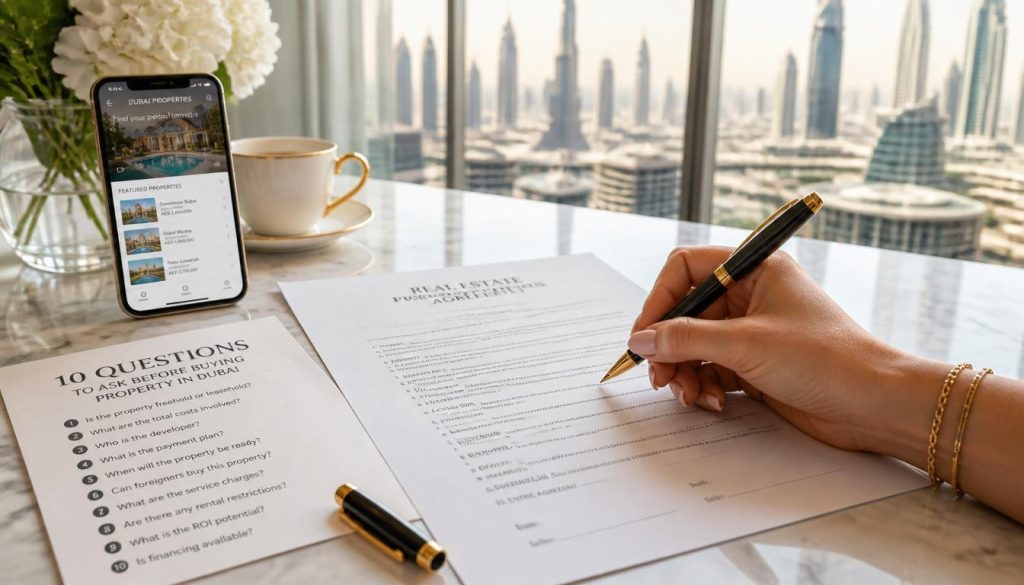
Choosing a restaurant takes about five minutes. Choosing a real estate agency to handle a transaction worth hundreds of thousands of dirhams? Most people do it in about the same time.
That’s the problem.
Dubai’s property market recorded over 180,000 real estate transactions in 2024 alone, according to the Dubai Land Department (DLD). That pace and the money moving through it means that hiring the wrong agency is not a minor inconvenience. It can cost you weeks of delays, a bad deal, or worse: a legally messy transaction that takes months to untangle.
The good news is that a few direct questions, asked before you sign anything, will tell you almost everything you need to know. This guide covers all ten of them specifically for the Dubai and UAE market, where the rules, the regulations, and the red flags are different from anywhere else in the world.
Use this as your checklist. Bring it to every agent meeting.
1. Are You RERA-Certified and Registered With the Dubai Land Department?
This is the first question — non-negotiable, full stop.
In the UAE, all real estate agents must hold a valid RERA certification, issued by the Real Estate Regulatory Agency under the Dubai Land Department. Every licensed broker has a Broker Registration Number (BRN). If an agent can’t hand you that number immediately, that’s your answer.
You can verify any broker’s BRN directly through the official DLD REST app (dubai.rest.ae) in under a minute. It’s free, it’s official, and it tells you whether the license is active.
Why does this matter beyond box-ticking? Because a RERA-certified agent has passed regulated training, understands local property law, and is accountable to a governing body if something goes wrong. An uncertified agent offers you none of that protection.
As of 2025, over 15,000 licensed real estate brokers operate in Dubai. Not all of them are equally qualified but at minimum, verify that the person you’re trusting with your investment is actually authorized to practice.
Red flag: Any hesitation, vague claims about “experience being enough,” or inability to share their BRN within 60 seconds of you asking.
2. How Well Do You Know This Specific Area — Not Just Dubai in General?
“I know all of Dubai” is not a useful answer. It’s also almost never true in the way that matters.
The real estate market in Jumeirah Village Circle behaves differently from Business Bay. Arabian Ranches villas attract a different buyer pool than Downtown apartments. An agent who genuinely specializes in a neighbourhood knows the micro-pricing, the buyer sentiment, the upcoming supply pipeline, and the building-by-building quirks that affect value.
Ask for their last 10–12 closed transactions in the area you care about. If they can’t name actual streets, buildings, or recent comparable sales with confidence, they’re a generalist operating outside their depth.
According to Property Monitor’s 2024 data, agents working within their core specialization area close transactions approximately 23% faster than those working outside it. In a market where timing affects your final price, that gap is significant.
If you’re comparing specific neighbourhoods, our guide to Dubai’s top residential communities can help you understand what to look for area by area before the conversation even starts.
Red flag: A broad portfolio spanning 10+ completely different areas with no clear focus.

3. What Are Your Sales Numbers — Days on Market, Volume, and List-to-Sale Ratio?
Good agents track their performance. Great agents can tell you their numbers without having to look them up.
Three metrics matter most when you’re evaluating an agent’s track record:
- Days on market (DOM): How long do their listings actually sit before selling?
- List-to-sale price ratio: Are they achieving asking price, above it, or consistently taking haircuts?
- Sales volume: How many transactions have they completed in the last 12 months?
Dubai’s secondary market average DOM in 2024 sat between 45–60 days. An agent consistently closing below that benchmark is outperforming the market, which means your property (or your search) benefits directly.
Ask plainly: “What was the average DOM for your last ten listings? What percentage of asking price did you achieve?” A capable agent will answer without flinching.
Understanding how the real estate market is currently trending in Dubai is also worth doing independently so you know whether the numbers an agent quotes you match current reality.
Red flag: Inability or unwillingness to share concrete performance data. Vague claims about “always getting top price” are not data.
4. Do You Handle Off-Plan, Secondary Market, or Both — and What Does That Mean for My Deal?
This question is unique to Dubai, and almost no other real estate guide in the world will tell you to ask it.
Off-plan transactions buying directly from a developer before a building is complete follow a completely different legal and financial process than buying a ready property in the secondary market. The documents, the registration system, the payment structure, and the protections are all different.
Off-plan involves the Oqood system (the official off-plan property registration portal managed by DLD), a Sales Purchase Agreement (SPA) with the developer, and structured payment plans tied to construction milestones. You can read more about what Oqood means for your off-plan purchase before walking into any conversation about a new development.
Secondary market transactions involve a Memorandum of Understanding (MOU), a No Objection Certificate (NOC) from the developer, and DLD transfer registration a different checklist entirely.
If you’re buying off-plan, ask: “What developer relationships do you hold, and how do you verify projected handover timelines?” If buying secondary, ask: “Walk me through the MOU to transfer process. What’s your role at each step?”
An agent who specialises only in one type and is honest about it is more trustworthy than one claiming equal expertise in both.
Red flag: An agent pitching off-plan projects without mentioning Oqood registration or developer escrow accounts.
5. What Exactly Are Your Fees — and What’s Actually Included?
Dubai has a standard agency commission structure: typically 2% of the purchase price for buyers, and 2% for sellers. But what’s inside that 2% varies considerably between agencies.
Some agencies include professional photography, drone video, and marketing spend. Others charge for every extra. Some add admin fees for DLD coordination. Some charge separately for NOC processing. You need to know all of this upfront in writing.
RERA mandates that all agency fees be disclosed in official documentation. For sellers, this is the Form A (the listing agreement). For buyers, it’s the Form B (buyer representation agreement). These are not optional forms they are the legal foundation of your working relationship with an agent.
If an agent is vague about what their fee covers, or reluctant to put the full breakdown in a signed Form A or Form B, that is a serious warning sign. Our post on real estate agent commission structures in Dubai breaks down exactly what buyers and sellers should expect to pay — and what’s negotiable.
Also be aware of hidden costs when buying property in Dubai that go beyond agency fees DLD transfer charges, mortgage registration fees, and NOC costs all add up.
Red flag: Verbal-only fee agreements. If it’s not in a signed document, it doesn’t legally exist.
6. What Is Your Marketing Strategy — Beyond Just Listing It Online?
“I’ll list it on Property Finder and Bayut” is the minimum. It is not a marketing strategy.
Over 78% of property searches in Dubai begin on digital platforms (Bayut/Property Finder Annual Report, 2024). That means listing quality photos, video, written description, and featured placement directly affects how many qualified buyers see your property, and how seriously they take it.
A real agent will come to your meeting with a written marketing plan. Ask to see one. It should include professional photography (not phone shots), drone video if applicable, a targeted social media campaign, database outreach to qualified buyers, and a timeline.
Also ask: “Do you pay for featured listings or sponsored placement on portals?” Sponsored listings on Property Finder receive 3–5x more views than standard listings. An agent who won’t invest in that visibility is asking you to compete with your hands tied.
If you’re preparing a property for sale, consider reading about home staging tips that sell Dubai properties faster — because great marketing starts before the photographer arrives.
Red flag: No written marketing plan, no professional photography policy, or reluctance to explain how they attract buyers beyond portal listings.
7. Who Actually Handles My Property From Start to Finish?
Large agencies sometimes operate with a senior agent who wins the listing and then hands it to a junior team member who handles everything else. This isn’t inherently wrong, but you need to know about it before you agree to anything.
Ask directly: “Will the person I’m speaking with today be the same person managing my showings, communicating updates, and negotiating on my behalf?”
If the answer is no, ask to meet whoever will actually be handling your account. Understand who you call when there’s a problem. Understand who updates you on showing feedback. Accountability gaps in the chain are where deals fall apart.
You should also understand the difference between how a real estate agent and a brokerage firm operate before you engage either. Our post on real estate agent vs. broker clarifies the distinction in the UAE context.
Red flag: Vague references to “the team” with no clear primary point of contact.
8. How Do You Negotiate — Can You Give Me a Real Example?
Negotiation is where agents earn their commission. Or don’t.
Don’t accept general statements. Ask for a real story: “Tell me about a recent deal where your negotiation skill made a meaningful difference for your client.” Listen for specifics numbers, timelines, what the counteroffer was, how they handled pushback.
According to CBRE’s 2024 UAE Residential Report, there is still a 5–8% negotiation margin available in most Dubai secondary market transactions. A skilled agent captures that gap for you. An unskilled one leaves it on the table or lets you overpay.
For sellers, also ask: “How do you handle multiple offers?” The answer reveals whether they know how to create competition among buyers, or whether they’ll just present whatever comes in sequentially and hope for the best.
Red flag: Generic claims about “always fighting for the best price” with no supporting examples.
9. What Is the Cancellation Policy If I’m Not Happy After 30 Days?
This is the question most people never think to ask until they need to.
When you sign a Form A in Dubai, you are entering a legally binding exclusive listing agreement. The exclusivity period typically runs between 30 and 90 days, depending on what’s negotiated.
During that period, your options for switching to another agent are limited unless the contract allows for early termination.
Ask before you sign: “What are my options if I want to exit this agreement after 30 days of no results?” A confident, experienced agent will be comfortable discussing exit clauses. They’ve earned their clients’ loyalty through performance, not through contractual lock-in.
Understand also what documents are required when selling property in Dubai so you understand the full picture of what you’re committing to when you sign a listing agreement.
Red flag: Agents who push for 90-day exclusivity with no performance benchmarks, or who become defensive when you raise early termination.
10. Can You Walk Me Through the Full Transaction Process — Step by Step?
This is your final filter, and it’s one of the most revealing questions you can ask.
A competent agent should be able to walk you through the full Dubai transaction process without hesitation:
For secondary market buyers: Offer → MOU signing (with 10% deposit) → NOC application from developer → DLD transfer registration → handover.
For off-plan buyers: Reservation → SPA signing with developer → Oqood registration → payment plan milestones → DLD registration at completion → handover.
If an agent fumbles, skips steps, or can’t explain what happens after the MOU is signed, they are not equipped to manage your transaction when it gets complicated — and it almost always does.
For reference, how long a full property transaction takes in Dubai depends heavily on agent preparation. A well-coordinated transfer can complete in 2–5 business days at DLD. Poor agent preparation regularly stretches that to 6–8 weeks.
Also make sure you understand DLD fees and property selling fees in Dubai before your final closing conversation, so no number at the finish line surprises you.
Red flag: Vague, halting, or incomplete answers about post-offer process. An experienced agent describes this in their sleep.
The Bottom Line
Hiring a real estate agency in Dubai is not a favour you’re doing someone. It’s a business decision involving significant money in a regulated, fast-moving market. The agent you choose becomes your legal co-signatory, your negotiation representative, and your guide through a process most people only go through a handful of times in their life.
These ten questions take 20 minutes to ask. They can save you months of frustration, tens of thousands of dirhams in value, and the kind of legal headaches that don’t resolve quickly.
If you’re ready to work with a RERA-certified team that answers every one of these questions directly — and backs them up with transparent data and a proven track record in the Dubai market — speak with the team at 800 Homes.
We don’t just find you a property. We protect your investment from the first conversation to the final handover.
