

Summary: Etihad Rail links the UAE’s national railway infrastructure with a growing passenger network. Scheduled Abu Dhabi–Fujairah services began in June 2026, with Dubai joining the September expansion. For property buyers, the useful question is how easily a home connects to an open passenger station, onward transport and the places they visit regularly. Rail access adds a location factor; it does not establish a guaranteed property return.
Looking at the Etihad Rail map can help you plan more than a train journey. It can also help you compare where to live, how to reach work and which transport connections deserve attention when buying a home. This guide explains the stations, routes and announced expansion, then examines the practical property considerations around Dubai and other UAE rail connections.
The Latest Etihad Rail Map and What it Shows
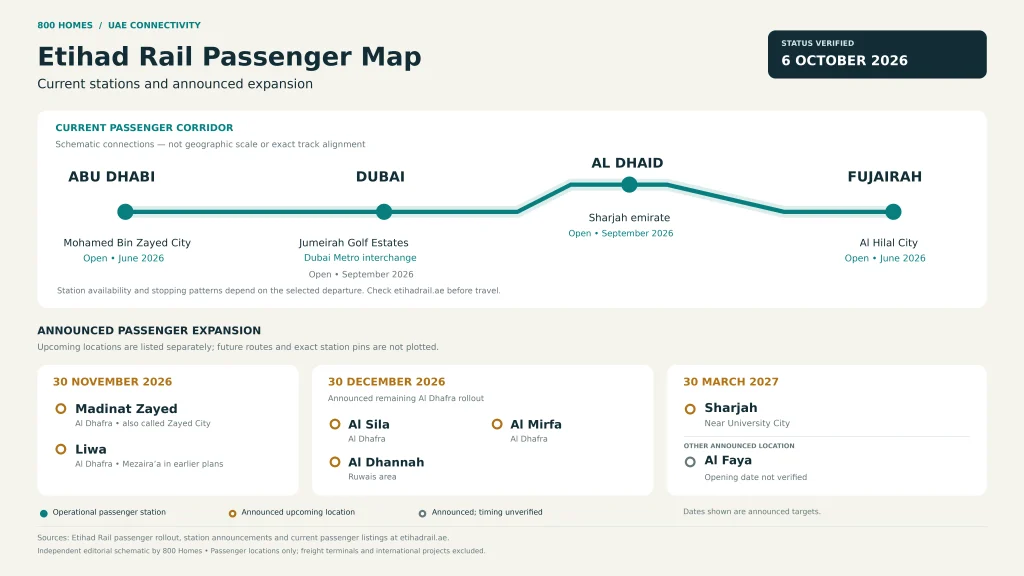
Use the official passenger network map when planning travel. A full UAE railway map may show freight infrastructure, future connections and places that are not available as passenger stops. A line crossing an emirate does not mean you can board a train there.
View the official Etihad Rail network map and journey planner
Read the station name and service status alongside the route. Operational stations support passenger journeys; announced upcoming stations should be treated as future access. Freight terminals serve cargo. These distinctions also matter when a property advertisement describes a development as being near Etihad Rail.
If you need an Etihad Rail map PDF, start with the operator’s current map. If a downloadable file is unavailable, save or print the official page where supported. Date your copy and check it against the live journey planner before travelling. An old map, including a 2024 route map, may describe infrastructure rather than today’s passenger services.
What Etihad Rail is
Etihad Rail is the UAE’s national railway organisation, with freight infrastructure and a passenger service expanding in phases. Its completed national network was described as approximately 900 kilometres in the February 2023 completion announcement. Earlier project material referred to a wider 1,200-kilometre plan; those figures describe different scopes and should not be used interchangeably.
Freight and passenger services have different purposes. Freight rail links industrial activity and logistics networks. Passenger rail offers travel between cities and regions. For residential property decisions, access to an operating passenger station is more useful than proximity to tracks or a cargo facility.
Passenger services and the current network
Scheduled passenger services between Fujairah and Abu Dhabi began on 30 June 2026. The Dubai launch announcement set 30 September 2026 as the start of services connecting Abu Dhabi, Dubai and Fujairah. Al Dhaid was included in the operator’s September station rollout. Check the official booking system for the available departures and stops on your date.
The full announced passenger network covers 11 cities and regions. This is the expansion footprint, not a statement that all 11 have open stations today. The operator’s published rollout includes additional Al Dhafra stations and Sharjah after the September expansion.
Etihad Rail stations and announced opening dates
| Station or area | Location or naming context | Passenger status as of 5 October 2026 |
| Abu Dhabi | Mohamed Bin Zayed City | Operational since 30 June 2026 |
| Dubai | Connected to Jumeirah Golf Estates Metro | Services announced from 30 September 2026 |
| Fujairah | Al Hilal City | Operational since 30 June 2026 |
| Al Dhaid | Sharjah emirate | September rollout; check bookable stops |
| Madinat Zayed | Al Dhafra; also described as Zayed City | Announced for 30 November 2026 |
| Liwa | Mezaira’a naming appears in earlier plans | Announced for 30 November 2026 |
| Al Sila | Al Dhafra | Remaining Al Dhafra rollout announced for 30 December 2026 |
| Al Dhannah | Ruwais area search intent | Remaining Al Dhafra rollout announced for 30 December 2026 |
| Al Mirfa | Al Dhafra | Remaining Al Dhafra rollout announced for 30 December 2026 |
| Al Faya | Announced passenger network location | Listed in the network; separate opening not verified here |
| Sharjah | University City station connection | Announced for 30 March 2027 |
Sources: operator station list, passenger rollout and Al Dhafra announcement [3,5,6]. Opening dates are announced targets for future stations. The December date is a regional rollout announcement, so confirm individual station availability before relying on it. Al Dhaid is in Sharjah emirate and should not be confused with the separate Sharjah city station.
Where Dubai Etihad Rail Station is
Dubai’s Etihad Rail passenger station connects directly to Jumeirah Golf Estates Metro Station through a dedicated pedestrian bridge. This makes the Jumeirah Golf Estates connection the relevant starting point for passengers researching the Dubai Etihad Rail station location or station map.
Use the operator’s station pin for the entrance and your journey planner for onward travel. A community name can describe a broad area, while the station entrance occupies a specific site. Check the actual route from your building rather than estimating access from the name alone.
The Metro interchange and the last mile
The Metro interchange lets passengers continue into Dubai’s urban transport system. For a resident, however, the complete trip still includes reaching the national rail platform and travelling from the arrival station to the destination. Transfers, walking, queues and taxi or bus connections can change whether the service is practical for daily use.
When comparing homes, test the station journey at the time you would normally travel. A short-looking route may involve a major road crossing, a long building exit or a community gate. Ask whether the usable route is shaded, accessible and comfortable in summer. A nearby home that requires a taxi for every trip may have a different transport cost from one with a convenient feeder connection.
Al Yalayis and Jebel Ali Station Searches
Searches for Al Yalayis, Jebel Ali and Dubai station can refer to different parts of the wider railway and surrounding development corridors. The verified Dubai passenger connection in this guide is the station linked to Jumeirah Golf Estates Metro. Do not assume an Al Yalayis reference identifies a separately bookable passenger stop.
Jebel Ali’s freight and logistics relevance also does not establish a public passenger station called Jebel Ali. If you live or work in that area, search from your actual address to the open Dubai passenger station and confirm the onward transport. A freight map cannot settle a residential commute question.
Dubai Communities to Compare for Rail Access
Jumeirah Golf Estates is the clearest community context for the Dubai interchange. Other areas can enter a buyer’s shortlist when their transport routes and budget suit the household, but inclusion below is a comparison suggestion rather than a measured proximity claim or investment ranking.
| Community or corridor | Reason to include in a shortlist | What to verify for the specific home |
| Jumeirah Golf Estates | Direct relevance to the named Metro interchange | Community gate, station entrance and usable walking or driving route |
| Dubai Production City and Meaisem | Alternative residential options to compare | Peak-time feeder trip, building access and total commute |
| Dubai Investment Park | Compare connections through the Metro network | Actual Metro transfer and travel time to the rail platform |
| Jumeirah Village Circle and Jumeirah Village Triangle | Broader Dubai residential alternatives | Taxi or bus dependence and cost for repeated station trips |
| Al Yalayis and Dubai South corridors | Longer-term development comparison | Existing access versus planned roads and transport promises |
For Jumeirah Golf Estates property, the national rail connection adds a mobility consideration alongside the community’s existing residential appeal. Its value to a buyer depends on whether the household actually uses the destinations served. Someone making regular inter-emirate trips may evaluate that convenience differently from someone whose routine is entirely local.
Compare the same property type and approximate size across your shortlist. A villa, townhouse and apartment have different costs and lifestyle benefits; transport access alone cannot explain the price difference. Consider schools, everyday shopping, parking, maintenance, community facilities and the route to your workplace before paying more for a station-related sales claim.
Find a Home That Fits Your journeys
Looking for a Dubai home with better transport access? Start with your budget, workplace and preferred travel routine, then compare properties with practical links to Metro, Etihad Rail and major roads.
Explore properties for sale with 800 Homes
Where Abu Dhabi Etihad Rail Station is
Abu Dhabi’s passenger station is in Mohamed Bin Zayed City. The operator’s station page identifies the location as ME10. It is the station used by the inaugural scheduled service from Fujairah.
Queries mentioning Mussafah or Shabiya should be answered with this specific passenger location rather than a generic Abu Dhabi pin. These neighbouring area searches may help users orient themselves, but they should not be presented as additional passenger stations without an operator listing.
Residential Access Around Mohamed Bin Zayed City
For people considering homes in Mohamed Bin Zayed City or surrounding residential areas, assess the journey to the station together with the journey to work, school and essential services. A national rail connection can support travel outside the emirate, while many daily errands still require local transport.
If you are comparing living in Abu Dhabi with working in Dubai, test both ends of the commute. Include early departures, the last return service and a fallback journey if a meeting finishes late. Before renting or buying, make the trip on an ordinary workday rather than relying on a weekend viewing.
Where Fujairah Etihad Rail Station is
Official project material identifies Fujairah’s passenger station in Al Hilal City. Passenger operations began on the Fujairah–Abu Dhabi corridor in June 2026. Use the official station location and booking system to confirm the entrance and your chosen service.
For Fujairah residents, rail offers another way to make inter-emirate journeys. Property comparisons should remain local: evaluate neighbourhood amenities, the actual station trip and the frequency with which the household travels to Abu Dhabi or Dubai. Coastal lifestyle preferences, employment and everyday convenience may matter more than rail access for some households.
A station serving Fujairah city does not make every property in Fujairah emirate close to passenger rail. Describe a home’s measured road or walking route and the transport mode used. Avoid presenting an emirate-wide connection as a property-specific access claim.
Sharjah Al Dhaid and the Northern Emirates
Al Dhaid and Sharjah city are separate station contexts. Al Dhaid was included in the September rollout; Sharjah Station is announced for 30 March 2027. The Sharjah project announcement identifies a connection involving University City.
For Sharjah property buyers, an inland Al Dhaid location and a University City connection serve different routines. Choose the relevant station first, then assess your home-to-station route and onward journey. A property convenient for one connection may be poorly placed for the other.
Ajman, Ras Al Khaimah and Umm Al Quwain appear in rail-related searches, but they are not individually named in the verified 11-location passenger list used here. That does not settle every future infrastructure plan. It means this guide does not identify an open, bookable passenger station in those emirates. Consult the operator’s current station directory before planning a trip or buying on a promised future stop.
For a home in the Northern Emirates, the useful comparison may be access to a passenger station elsewhere. Calculate the complete feeder journey; a lengthy drive to rail can remove much of the benefit of changing transport modes.
Al Dhafra Stations Including Ruwais Mirfa and Liwa
The western passenger expansion includes Al Sila, Al Dhannah, Al Mirfa, Madinat Zayed and Liwa. Earlier network announcements use Mezaira’a for the Liwa location. Madinat Zayed and Liwa are announced for 30 November 2026, with the remaining Al Dhafra stations scheduled for December.
If you search for Etihad Rail Ruwais station or Ruwais to Abu Dhabi, look for the operator’s Al Dhannah naming as well. Local place names and passenger station labels may differ. Confirm the station offered in the booking system before treating it as available.
For property decisions in Al Dhafra, focus on the local housing need and employment pattern. A station can add travel choice, but a future opening should remain a future assumption in your comparison. Rental demand, property availability and the ability to resell must be evaluated independently of a railway announcement.
Etihad Rail Routes and Journey Times
| Route search | Verified context | How to use it |
| Abu Dhabi to Dubai or Dubai to Abu Dhabi | September announcement introduces Dubai services | Use live departures for duration, stops and return options |
| Abu Dhabi to Fujairah | June inaugural journey took 1 hour 45 minutes | Historical service example; check your selected departure |
| Dubai to Fujairah | Included in the September network announcement | Confirm the particular service and travel time |
| Ruwais or Al Dhannah to Abu Dhabi | Western passenger expansion is announced | Check availability after the individual station opens |
| Dubai to Al Ain | No current direct route verified for this guide | Do not use earlier proposed times as live schedules |
Sources: A published train duration is a station-to-station figure. It should not be compared directly with a door-to-door driving journey. The original article’s 50-minute Abu Dhabi–Dubai and Dubai–Fujairah promises are omitted because a current timetable must establish those values.
Compare the Full Commute
A useful comparison adds home-to-station travel, arrival allowance, train time, transfers and the final trip to work. It also accounts for the number of departures that fit your routine. The fastest train is not necessarily the most useful service if it departs before you can reach the platform.
Illustrative calculation, not a timetable: 15 minutes to reach a station, 15 minutes for boarding allowance, a hypothetical 60-minute rail journey and 20 minutes to reach work total 110 minutes. Your own route may be shorter or longer. Use measured access times and a bookable departure when comparing homes.
For costs, add return rail fares, feeder transport and parking where applicable. Compare that total with fuel, parking, tolls and the other costs of driving. Include the value you place on being able to read or work during the train journey, while recognising that this benefit varies by person.
Tickets Fares and Booking
Book through Etihad Rail’s official website or mobile app; the September Dubai announcement also lists station ticket vending machines. That announcement gives starting fares of AED39 for Comfort Class and AED109 for Premium Class. These are advertised starting prices, not a fixed fare for every route or date.
Check current fares and book an Etihad Rail journey
Select your origin, destination and date, then review the departure, arrival time, class, baggage terms and change or cancellation rules before payment. Confirm the last return train if you are planning an evening trip. For repeated commuting, use the currently offered fare products rather than assuming a monthly pass or discount exists.
Station and onboard features should also be checked for your journey. If you need step-free access or assistance, consult the operator before travelling. Do not assume every station has identical retail, parking or transfer arrangements simply because the network uses common branding.
Etihad Rail and Dubai Metro for Property Buyers
Etihad Rail is a national railway service, while Dubai Metro supports urban travel within Dubai. The Dubai interchange connects the two. A property may offer convenient Metro access but still involve a transfer and additional time before boarding an inter-emirate train.
| Comparison | Etihad Rail | Dubai Metro |
| Main travel role | Journeys between cities and regions | Journeys within Dubai |
| Property access question | Can you reach the passenger station and suitable departure | Can you reach a station on a useful urban route |
| Dubai connection | Pedestrian bridge to Jumeirah Golf Estates Metro | Onward urban travel from the interchange |
| Planning tool | Operator booking and journey planner | Current RTA route and journey information |
For a household travelling both locally and between emirates, compare access to each system. Keep planned Metro extensions separate from existing connections. A future interchange can be relevant to a long-term location review, but it should not be described as available today.
How Rail Connectivity Could Influence Real Estate
Rail can change the places a household considers practical to live. A reliable inter-emirate trip may make a residential area worth comparing when driving previously felt inconvenient. This is a potential change in location preferences, not evidence that prices have already increased because of the railway.
Commuting Options and Residential Demand
The property question begins with a specific resident. Where do they work, when do they travel and how often? If a station offers suitable departures and a manageable final journey, nearby housing may suit their routine. If the workplace is far from the arrival station, a home close to rail may deliver less benefit than expected.
Investors should assess whether that routine matches the likely tenant for the property. Family tenants may prioritise schools and space; frequent business travellers may put more weight on rail access. Explain the intended tenant and test the proposition against local leasing evidence rather than describing all station-area homes as equally attractive.
Accessibility and Future Development
Station connections can add a reason to consider an area alongside roads and local public transport. Their usefulness depends on service frequency, affordable fares and the quality of the last mile. A property with a straightforward connection can be more convenient for a particular household than one closer to the tracks but separated by difficult access.
Future urban development around rail may create additional amenities or employment, but an announcement is not a completed neighbourhood. Check which roads, facilities and projects are already usable, which are under construction and which remain proposed. Compare your intended ownership period with the likely delivery period.
Track Proximity and Residential Comfort
Living beside a rail corridor can involve different considerations from living near a passenger station. Visit the home, ask about the corridor and examine noise, privacy, access and building quality. Do not assume freight activity improves residential desirability or that a track view guarantees convenient travel.
For commercial and industrial property, freight connectivity may be relevant to logistics operations. That requires a separate assessment of terminal access, permitted use and the occupier’s needs. Residential buyers should avoid importing a freight-investment argument into a home purchase.
A Property Comparison Around Key Rail Connections
| Rail connection | Residential market to investigate | Useful comparison | Evidence still needed |
| Dubai interchange | JGE and shortlisted Dubai alternatives | Whole journey to rail and everyday destinations | Actual entrance route and current listings |
| Abu Dhabi MBZ City | MBZ City and surrounding areas | Workplace access plus inter-emirate travel | Measured commute and comparable local properties |
| Fujairah Al Hilal | Relevant Fujairah neighbourhoods | Lifestyle and frequency of travel outside the emirate | Specific property access and local demand |
| Al Dhaid | Central Sharjah residential options | Local routine plus regional trips | Bookable stops and suitable onward journeys |
| Future Sharjah station | University City catchment to assess | Existing transport and future rail scenario | Opening confirmation and property-specific route |
| Future Al Dhafra stations | Local residential markets near announced locations | Employment and housing needs | Individual opening and comparable rental evidence |
This table identifies research areas rather than recommended investments. No price-growth percentage, rental yield or distance is attributed to these locations without a dated property dataset and measured station access.
Should You Buy Property Near an Etihad Rail Station
Station access deserves weight when it solves a real travel need and the home also fits your budget and living requirements. Before committing, work through the following checks with the specific unit and station entrance.
- Confirm the open passenger station and a departure that fits your routine. Keep future openings in a separate scenario.
- Measure the usable route from the building or community gate, including feeder travel and transfers.
- Compare equivalent homes using recent transaction or rental evidence; asking prices alone do not establish achieved values.
- Calculate the full ownership or rental cost, including recurring building costs and transport spending.
- For an investment, examine realistic rent, vacancy, maintenance and service charges, then test a lower-rent scenario.
- Visit the property at busy travel times and inspect any noise or access issue beside the railway.
- Check the unit, developer or seller documentation and obtain qualified advice on ownership eligibility, finance and transaction requirements for that emirate.
The strongest purchase case should still make sense if rail adds less value than expected. A home with suitable amenities, manageable costs and demand supported by local evidence is easier to assess than one whose sales case depends entirely on future transport-related appreciation.
Discuss your Dubai property investment objectives with 800 Homes
Freight Infrastructure Sustainability and Regional Connections
Etihad Rail’s national freight operations have been established since 2023. The operator describes rail as a means of moving high volumes of cargo and reducing truck movements and emissions per tonne. These benefits concern the logistics system and should not be converted into an assumed property-price premium.
For a resident, environmental benefits depend on the journey and mode replaced. Convenient onward public transport can improve the usefulness of a rail trip. This guide does not assign a universal carbon saving to every passenger journey or promise that a home beside the tracks will experience less noise.
Regional rail plans also require separate status labels. Hafeet Rail describes the UAE–Oman railway as under construction and says its operational timeline is being established. Its published project context includes Al Ain and Sohar. This does not establish an operating Dubai–Al Ain passenger service or an available international ticket.
A GCC railway map may show a regional ambition extending beyond the current UAE passenger service. Do not treat mapped connections to Saudi Arabia, Oman or other GCC countries as a seamless, bookable journey unless the relevant operators confirm the service. For property planning, distinguish an existing transport advantage from a possible future connection.
Frequently Asked Questions
Where is Etihad Rail Dubai Station
It connects to Jumeirah Golf Estates Metro Station through a dedicated pedestrian bridge. Use the operator’s station map for the exact entrance and access route.
Is Etihad Rail Running Between Dubai and Abu Dhabi
The Dubai launch announcement introduced services linking Abu Dhabi, Dubai and Fujairah from 30 September 2026. Confirm available departures in the booking system.
Where is Etihad Rail Abu Dhabi Station
The passenger station is in Mohamed Bin Zayed City, with ME10 listed on the operator’s station page.
Which Stations are Currently Open
Abu Dhabi and Fujairah began scheduled services in June; Dubai and Al Dhaid were included in the September expansion. Check the live station list for bookable stops.
How Do I Find The Nearest Etihad Rail Station
Use your actual address and the operator’s open passenger station list. Compare a usable travel route rather than straight-line distance or nearby railway tracks.
Does Etihad Rail Connect with Dubai Metro
Yes. The Dubai station connects with Jumeirah Golf Estates Metro through a pedestrian bridge. Allow time for the transfer.
Is There an Etihad Rail Passenger Station at Jebel Ali
This guide does not verify a separately bookable Jebel Ali passenger station. Freight or port connectivity does not establish a public passenger stop.
Does Etihad Rail go to Al Ain
An operating Al Ain stop is not identified in the verified 11-location passenger list here. Hafeet Rail’s Al Ain project context concerns future UAE–Oman connectivity.
Are Ajman Ras Al Khaimah and Umm Al Quwain passenger stations open
They are not individually named in the passenger list verified for this guide. Check the operator for any newer station announcement; network coverage alone does not confirm an open stop.
When will Sharjah Etihad Rail Station open
The published rollout schedules Sharjah Station for 30 March 2027. Treat this as an announced future date and check for updates.
How long is the Abu Dhabi to Dubai train journey
Use the duration shown for your selected departure. Add station access, arrival allowance and onward travel to estimate a home-to-work journey.
Where can I find the full Etihad Rail map or a PDF
Start with the official network map on the Etihad Rail website. Use any operator-provided download where available and check the date of a saved copy.
Will Etihad Rail increase property prices
Station access may influence some buyers’ preferences, but this guide does not establish a causal price uplift. Local transactions, rents, supply and property quality remain necessary evidence.
Which Dubai communities should I compare for access
Begin with the Jumeirah Golf Estates interchange context, then assess individual homes in your wider shortlist against measured access, budget and daily needs.
Is Etihad Rail government or private
Etihad Rail is the UAE’s national railway organisation. Passenger operations are delivered by Etihad Rail Mobility, a joint venture with Keolis; that operational partnership should not be confused with a private property development.
Find a Dubai home with transport access that works for you
Considering a home because of Etihad Rail? Bring the comparison back to your own routine. The right property needs to work for your budget, everyday destinations and ownership plans as well as your train journeys.
Speak with 800 Homes about your preferred Dubai communities, property type and budget. Ask for a shortlist you can compare on actual transport access, available homes and the costs that matter to you. For an investment, discuss local rental evidence and your holding period before treating a station connection as a reason to pay more.
